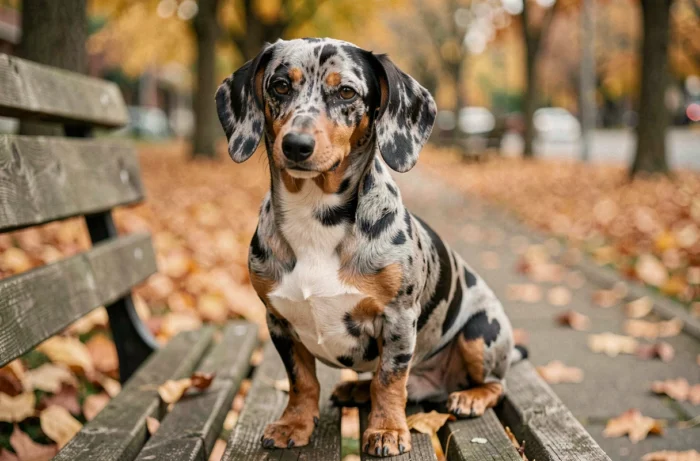
The harlequin dachshund refers to a dachshund whose coat features a marbled pattern, produced by a genetic variant called merle gene. This color pattern, made up of irregular lighter spots on a dark background, can appear in all sizes (standard, miniature, kaninchen) and all coat types of the breed. Each harlequin dog carries a unique pattern, which explains the growing appeal of this variant in Europe.
Merle gene and harlequin coat: what genetics really says
The terms harlequin, merle, and dapple refer to the same mechanism. The merle gene alters the distribution of pigments in the coat, creating diluted areas that give this spotted or marbled appearance. The base color remains variable: black and tan, chocolate and tan, fawn, sometimes silver gray depending on the expression of the gene.
A little-known point: a dachshund that appears solid may carry the merle variant in a subtle form. Appearance alone is not enough to determine a dog’s genetic status. Only an appropriate DNA test can confirm the presence or absence of the variant, which has direct consequences on breeding choices.
To learn everything about the harlequin dachshund and its genetic particularities, understanding this mechanism is a necessary prerequisite before any adoption.
The harlequin pattern can also influence eye pigmentation. Some merle dachshunds have blue eyes or heterochromia (one eye of each color), a phenomenon directly linked to the pigment dilution caused by the gene.
Specific health risks of the harlequin dachshund
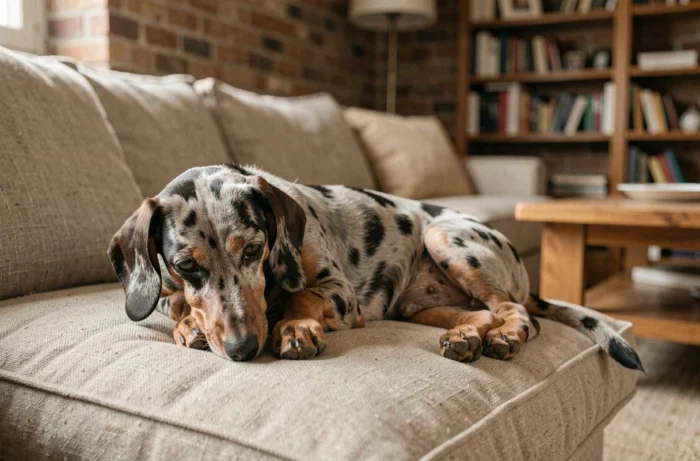
The harlequin coat is not just an aesthetic issue. The health risk depends on the genetic combination, not just the visible color. A dachshund that inherits only one merle variant (heterozygous) generally has a health profile comparable to that of any other dachshund. Problems mainly arise in dogs that receive a merle variant from each parent (double merle).
In these double merles, the risks of hearing and vision problems increase significantly. Developmental anomalies of the inner ear and eye can occur, ranging from partial deafness to blindness.
Three tests, three distinct pieces of information
Many prospective owners confuse the available screening tools. Each answers a different question:
- The DNA test identifies the merle variants carried by the dog, including those not visible to the naked eye. It is primarily used to inform breeding decisions.
- The BAER test (brainstem auditory evoked responses) separately assesses the hearing of each ear. An DNA result does not indicate the actual hearing ability of the dog.
- A clinical ophthalmological examination checks the condition of the eye structures. Again, the coat color does not predict the outcome.
These three assessments are complementary. A rigorous breeder uses them together before engaging in breeding involving merle subjects.
Character of the harlequin dachshund: the coat does not change temperament
The dachshund, regardless of its coat, retains a temperament shaped by centuries of selection for burrowing hunting. It is a lively, tenacious dog, sometimes stubborn, with remarkable scenting ability and a strong instinct to chase.
The harlequin color does not alter the dog’s character. A merle dachshund will have the same behavioral background as a solid black and tan dachshund: a strong attachment to its owner, measured distrust of strangers, and a tendency to dig and follow scents.
Early socialization remains crucial. The dachshund can be barky and possessive if its training lacks structure. Its small size should not overshadow the fact that it is a hunting dog, with the mental and physical stimulation needs that entails.
General health of the dachshund: beyond the harlequin coat
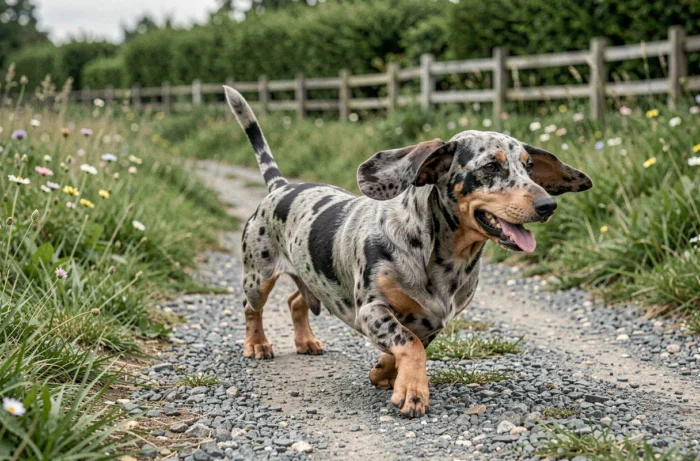
Focusing on the risks associated with merle can obscure a major issue of the breed. Intervertebral disc disease affects dachshunds regardless of coat color. This condition, linked to the breed’s elongated morphology and short legs, remains the leading cause of specialized veterinary consultations for dachshunds.
Prevention involves concrete actions: limit repeated jumps (sofa, stairs), maintain a strict ideal weight, prefer a harness over a collar for walks. These precautions apply to all dachshunds, harlequin or not.
Choosing a responsible breeder
The enthusiasm for the harlequin coat has fostered sometimes questionable breeding practices. Before adopting, a few criteria can help distinguish a serious breeder:
- The results of the merle DNA tests of both parents are provided spontaneously, without needing to ask for them.
- No double merle breeding is practiced, with both parents never carrying a merle variant.
- The puppies undergo a complete veterinary examination, including, if possible, a BAER test for harlequin litters.
- The breeder asks questions about the adopter’s lifestyle, a sign that they care about the placement of their puppies.
The rarity of the harlequin coat leads to prices generally higher than for a classic-colored dachshund. This extra cost does not guarantee anything in terms of health or compliance with the standard, hence the importance of checking genetic and clinical assessments before any commitment.
The harlequin dachshund remains, above all, a dachshund, with the qualities and requirements specific to this breed of German hunting dog. Its spectacular coat catches the eye, but it is the rigor of genetic screening and the quality of breeding that determine the dog’s long-term health.