An interior renovation project that combines technical interventions and decorative finishes requires rigorous sequencing. Starting decorative work before stabilizing the secondary work is like applying a coating on an unprepared surface: the result won’t hold. Here, we address the fine points that determine the success of an interior renovation and decoration project, assuming the initial diagnosis has already been established.
Indoor air quality and choice of decorative materials
The mandatory labeling of VOC emissions for construction products and coatings changes the game for decorative finishes. Paints, adhesives, decorative panels, laminate floors: each product used in a living space must display its emission class. Ignoring this parameter when choosing decor compromises the air quality of the home once the work is completed.
We recommend systematically selecting coverings classified A+ for VOC emissions. This requirement eliminates a significant portion of entry-level ranges in large stores, but it protects occupants in the long term, especially in bedrooms and poorly ventilated spaces.
Professionals working on projects that combine technical renovation and interior decoration now integrate this criterion from the specifications. Finding practical information on Zen et Déco allows for measuring the extent of the trades involved in this comprehensive approach.
For decorative wall panels or engineered wood floors, the manufacturer’s technical data sheet mentions the emission class. When it is absent, we discard the product. This simple rule avoids unpleasant surprises during the acceptance control.

Sequencing renovation work before decorative finishes
Structural and secondary work must be completed before any decorative intervention. Applying wallpaper before the filling compound has dried properly (drying time varies depending on the room’s humidity) leads to peeling within a few months.
The optimal sequencing follows a precise order:
- Demolition, masonry repairs, and installation of networks (electricity, plumbing, ventilation) before any work on visible surfaces
- Thermal insulation and air tightness treatment, which sometimes alter the final dimensions of the room and require recalculating the layout plans
- Installation of floor coverings before the installation of fixed furniture (kitchen, dressing), to ensure a clean result at the baseboards and thresholds
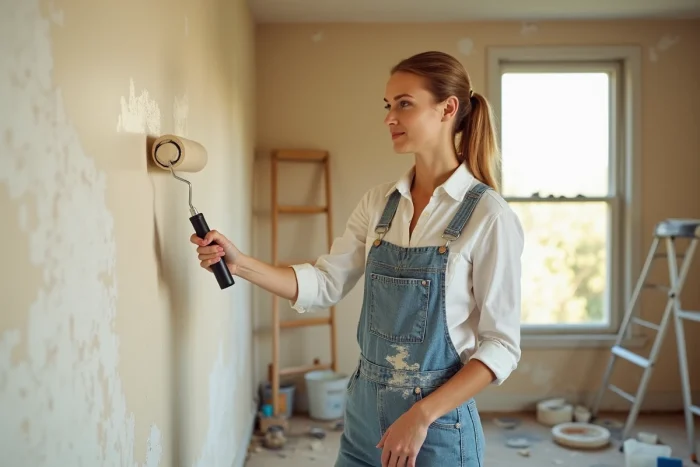
- Painting and wall finishes last, once construction dust is removed and humidity is stabilized
This phasing seems obvious on paper. In practice, the temptation to “start decorating” leads many homeowners to paint a wall before electrical work is completed. The result: costly corrections and a degraded finish.
Coordination of trades on a mixed site
A site that combines energy renovation and interior decoration involves several artisans working in sequence. The drywall installer goes before the painter, the tiler before the kitchen installer. A shared project schedule among all participants reduces downtime and intervention conflicts.
We observe that projects without centralized coordination accumulate an average of several weeks of delays. Designating a single point of contact, whether a project manager or a work coordinator, transforms project management.
Interior renovation budget: balancing between technical and aesthetic
Since the refocusing of MaPrimeRénov’ on large-scale renovations (“performance pathway”), the subsidy ceilings have been raised for insulation work, window replacement, and heating systems. This evolution directly modifies the distribution of the overall budget for a project combining renovation and decoration.
The prior energy audit now conditions access to the most significant aids. Even when the initial intention is purely aesthetic (remodeling a kitchen, modernizing a living room), this audit can reveal priority work that absorbs part of the budget originally allocated for decoration.
The decision then clearly arises: should the budget be allocated to insulating the walls from the inside (which slightly reduces the living space but lowers the energy bill) or to a high-end wall covering? The answer depends on the diagnosis, but we find that energy efficiency work generates a measurable return on investment, unlike purely decorative finishes.

Budget items often underestimated
Electrical compliance is the most frequently overlooked item in an interior renovation budget. An outdated electrical panel or non-compliant circuits requires a complete overhaul before any decorative intervention. This item often represents a significant portion of the total budget.
Ventilation is another blind spot. Installing a simple or double-flow VMC in an old home modifies openings, false ceilings, and sometimes the layout of the rooms. This type of intervention must be budgeted and planned before choosing light fixtures or wall colors.
Choosing colors and coverings: reasoning by the room’s use
The choice of colors is not solely based on aesthetic preference. In a north-facing living room, a saturated, warm hue compensates for the lack of natural light. In a bathroom, a wall covering must withstand water splashes and variations in humidity, which excludes certain non-specific wallpapers.
We recommend testing shades directly on the concerned wall, with a sample applied to a sufficient surface, and observing it at different times of the day. A color chart seen in-store under artificial lighting never renders the same result as in natural light in the target space.
The floor covering influences the overall ambiance more than the wall paint. A solid oak floor brings warmth that a high-end vinyl floor cannot replicate. This choice also affects the acoustics of the room, a parameter rarely considered in interior decoration projects.
Every technical decision made before the project, from the VOC classification of materials to the sequencing of interventions, determines the durability of the final result. A successful renovation and interior decoration project relies less on momentary inspiration than on the rigor of preparation.