
Sixty centimeters. That’s the distance that separates, on paper, the sink from the cooktop in most French kitchens. However, real life sometimes plays out within a ten-centimeter margin: in small apartments, some manufacturers are willing to go down to 40 cm, provided that nothing is left to chance in terms of safety. The presence of a dishwasher or bulky furniture often reshuffles the cards and forces one to work with constraints.
How to position the sink, cooktop, and fridge for a pleasant kitchen experience
The famous “activity triangle” is neither a fad of the century nor a fixed rule. It is based on years of experience: the goal is simple, to limit unnecessary movements for more comfort and efficiency when preparing meals. When the sink, cooktop, and refrigerator follow a logical sequence, everything becomes smoother: you take an ingredient out of the cold, rinse it, cook it, without hassle or unnecessary backtracking.
Generally, the ideal distance between each point of the triangle varies between 120 and 270 cm. The sink, a daily necessity, should always remain close to the cooktop, without turning the kitchen into a minefield. the distance between the sink and the cooktop remains a decisive parameter: too short, and splashes or burns threaten; too long, and transporting a full pot quickly becomes overwhelming.
The countertop makes the connection. Whether it’s an L-shaped, U-shaped, or a simple linear kitchen, planning a drop-off area of 40 to 60 centimeters between these two elements makes all the difference. You place dishes, vegetables, utensils there, you cut, you prepare, nothing accumulates unnecessarily. The refrigerator, in turn, naturally finds its place at the end of the activity triangle to remain accessible without creating a bottleneck with the slightest movement.
What distances to respect between each element to combine safety and practicality?
Setting the gap between the sink and the cooktop is not trivial: it touches on both comfort and safety. Kitchen designers agree that a minimum of 60 cm is necessary between the sink and the cooktop. This measurement limits the risk of water splashes on the cooking area and reduces dangers when handling hot dishes just taken off the heat. Decrease this number, and preparation quickly turns into a delicate exercise.
The countertop situated between the two should ideally measure between 40 and 60 cm, just enough to place, cut, and arrange without juggling. As for the space between the cooktop and the fridge, aim for 80 cm to ensure easy door openings and smooth circulation around. For the countertop, adopt a depth of 60 cm and adjust the height between 85 and 95 cm: these standards truly make daily work more pleasant.
Here are the key points to know for organizing your kitchen in a practical and safe manner:
- Distance sink / cooktop: minimum 60 cm
- Countertop area between the two: ideally 40 to 60 cm
- Space between cooktop and refrigerator: at least 80 cm
- Countertop depth: 60 cm
- Countertop height: between 85 and 95 cm
The electrical installation should not be overlooked. The NF C 15-100 standard governs what the connections dedicated to the cooktop should be, ensuring peace of mind and compliance. At every stage of the layout, respecting these distances makes movement fluid and limits mishaps.
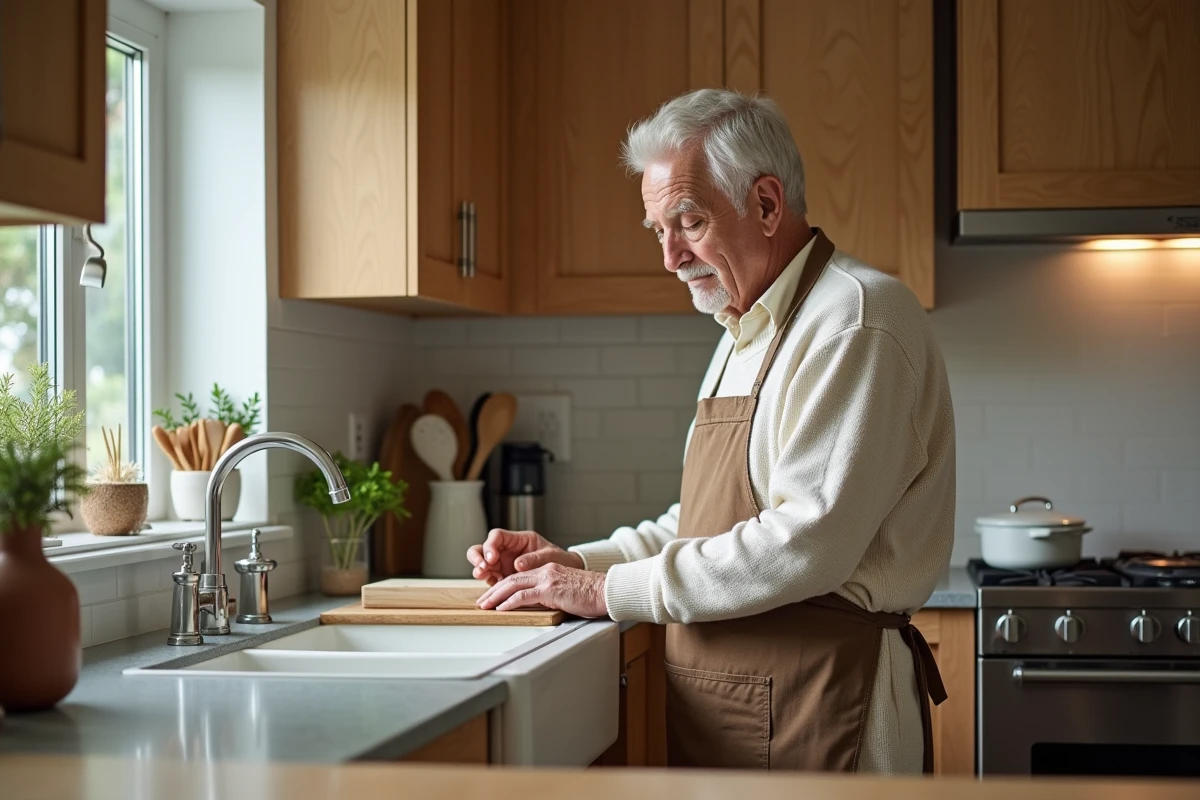
Smart tips to adapt recommendations to the size and shape of your kitchen
When space is limited, every centimeter counts. You can reduce the size of the countertop, but the area between the sink and the cooktop must always remain clear, or else it will cause constant inconvenience with each use. To avoid any danger in a room with corners, place the sink or the cooktop in the most accessible location on the plan, away from the corners.
Storage, a pillar of the compact kitchen, should free up as much surface area as possible: by installing columns or high cabinets, you facilitate movement on the floor and enjoy more ease in preparing your recipes. In a linear configuration, align the water, cooking, and preparation stations, always respecting the distances mentioned above. Those who opt for an open kitchen can play with flexibility by choosing a central island, while ensuring smooth circulation all around.
Whenever square meters allow, don’t hesitate to push the countertop depth to 65 or 70 cm: it’s a precious space for placing the mixer, toaster, or any other small appliance. And if the dining area needs to find its place, a foldable table or a compact snack bar can do the trick, as long as it doesn’t obstruct access to crucial areas.
Every time we adapt to the configuration of the space and think through the organization down to the smallest detail, the kitchen becomes a true playground, practical, safe, and enjoyable. It is neither the surface nor the shape of the room that determines the success of the layout, but the way each element is arranged to follow the rhythm of daily life. It’s up to everyone to invent their best recipe.