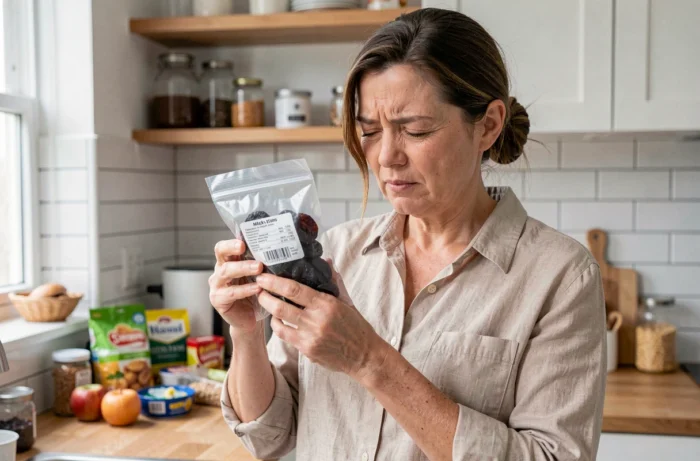
You find a bag of prunes at the back of the cupboard. The printed date has been exceeded for several months. The package seems intact, and the fruits have not changed in appearance. Should you throw them away or can they still be consumed? The answer depends less on the date itself than on what it really means and how the product has been stored.
DDM and DLC on prunes: two mentions, two logics
Before opening the bag, check the exact wording on the packaging. In France, two types of dates coexist on food products, and their implications are very different.
The use-by date (DLC) is written “to be consumed until”. It concerns perishable products (fresh meat, dairy products). Once exceeded, the product may pose a real microbiological danger.
The minimum durability date (DDM) is written “to be consumed preferably before”. It indicates that the manufacturer guarantees the product’s suitable qualities (taste, texture, nutritional value) until that date. Afterward, the product may lose quality without being automatically dangerous. According to the French Ministry of Economy, this distinction is a quality marker, not a signal of immediate danger.
Prunes, as dried fruits with low water content, carry a DDM. This is a game changer: the question of whether one can eat expired prunes without risk therefore hinges on this regulatory nuance, rather than on a cut-off date.
Dried prunes after the DDM: what really changes in the product
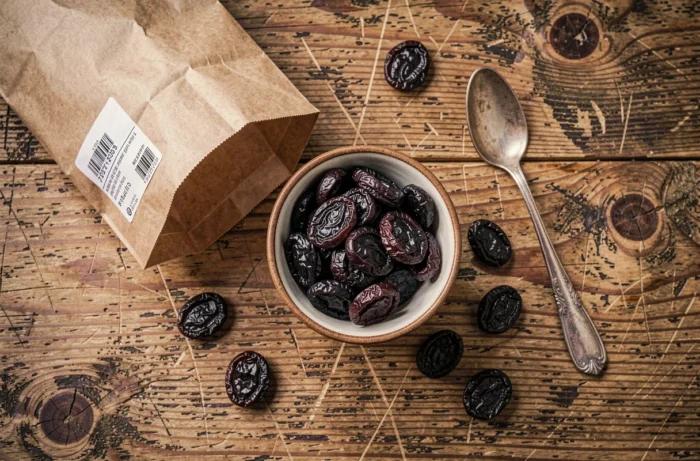
A prune whose DDM has passed does not become toxic overnight. Dried fruits benefit from very low water activity, which significantly limits bacterial proliferation. Drying removes a significant amount of water, creating an environment that is unfavorable to microorganisms.
What degrades gradually is something else:
- The texture may become harder or, conversely, stickier depending on storage conditions, especially if the bag has been exposed to temperature fluctuations.
- The taste dulls over time. The characteristic aromas of the prune fade, and a slight bitterness may appear after several months past the DDM.
- The content of certain nutrients (notably vitamins) gradually decreases, although fibers and minerals remain generally stable.
An expired dried prune loses taste quality before it poses a health problem. This degradation is slow and gradual, not abrupt.
Opened bag or closed bag: the real risk criterion
The DDM printed on the packaging is based on an assumption: the bag has remained closed and stored under good conditions. Once the package is opened, this date loses much of its relevance.
Exposure to ambient air and humidity changes the game. An opened bag left in a humid cupboard for several weeks can promote the softening of the prunes, the onset of fermentation, or even the development of mold. The Ministry of Economy reminds us that the actual storage conditions after opening matter more than the printed date.
In practical terms, an opened bag should be sealed tightly (with a clip, glass jar, or airtight container), kept dry and away from heat. A prune from a package that has been opened for a long time deserves careful inspection before consumption, even if the DDM has not been exceeded.
Warning signs to check before consuming
You may have noticed that a food can look normal on the surface but have started to deteriorate? This is particularly true for dried fruits. The absence of visible mold does not guarantee that the product is intact. Some alterations remain invisible or manifest in other ways.
Before eating a prune whose date has passed, check:
- The smell: a prune that smells sour, vinegary, or fermented should be discarded without hesitation.
- The texture: an unusual sticky appearance, a surface that sticks to the fingers abnormally, or the presence of suspicious whitish crystals deserve attention.
- The taste: if the first bite reveals a sour, sharp flavor, or simply one that is very different from the usual taste, spit it out and throw the rest away.
- The packaging: a swollen bag may indicate fermentation. A punctured or poorly sealed package exposes the product to external contamination.

Proper storage of prunes to extend their shelf life
A well-stored prune remains consumable well beyond its DDM. Drying is already an effective preservation method, but a few simple precautions significantly extend the product’s shelf life.
A dry, cool cupboard remains the ideal location as long as the bag is closed. Once opened, transferring to an airtight container (glass jar, food box with a seal) limits exposure to moisture and insects.
The refrigerator can be considered for long-term storage after opening, especially in summer or in a warm home. Prunes become a bit firmer there, but their consumption duration is extended. Some freeze them, which practically stops all degradation, even if the texture upon thawing differs slightly.
Organic or conventional: a difference for storage?
Organic prunes generally do not contain added preservatives (like potassium sorbate sometimes used in conventional ones). This absence may slightly shorten the consumption window after the DDM. In return, a well-stored organic prune in intact packaging remains reliable for several months after the date, just like its conventional counterpart.
The difference lies mainly in storage conditions, not in the product’s origin. A poorly stored conventional prune will degrade faster than a well-protected organic prune from air and moisture.
Systematically throwing away prunes whose DDM has passed, while they are intact and well-stored, contributes to food waste. Learning to distinguish the DDM from the DLC, and to assess the actual state of the product through your senses, allows for an informed choice. The nose, eyes, and palate remain the best allies for deciding.