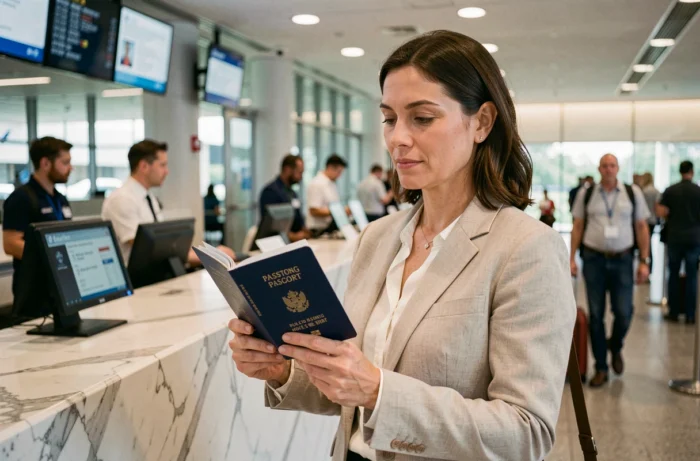
The French passport distinguishes between two lines: the visual zone (the identity page, readable by a person) and the machine-readable zone (MRZ), the two lines of characters at the bottom of the page.
On a passport issued after marriage, the identity page may show “DUPONT ép. MARTIN”, but the MRZ may include only the birth name. This discrepancy between what an agent reads and what the kiosk scans is the source of almost all boarding disputes.
Passport MRZ and married name: what kiosks actually read
Automated border control gates (Parafe in France, eGates in the UK) use only the MRZ. The name encoded in this zone is what the system compares with the ticket details sent by the airline through the API/PNR system.
When the MRZ contains only the birth name but the ticket was booked under the married name, the kiosk rejects the automatic match. The passenger is then referred to an agent. This may work at a French airport, where the abbreviation “ép.” is understood, but can cause a real problem at a foreign airport, where the abbreviation has no legal meaning.
The Services Publics+ platform has also documented user reports that the “ep” notation on French passports is not recognized abroad. We recommend checking your passport’s MRZ before booking: if it shows only your birth name, that is the name that must appear on your ticket.
So the question of traveling with a passport in your married name needs to be settled in advance, when entering your name during booking—not at the check-in desk.

Booking a plane ticket: which name to enter based on your passport
The rule is technical: the name on your ticket must exactly match the name in your passport’s MRZ. Not the name on the visual page, not the name on your ID card, and not the name in your family record book.
There are three possible scenarios, depending on your document.
- Passport issued before marriage: only your birth name appears throughout, including in the MRZ. Book under your birth name—no ambiguity.
- Passport issued after marriage with a married name added: the identity page shows “BIRTH NAME ép. MARRIED NAME”, but the MRZ may contain only your birth name. Check the MRZ and book using the name shown there.
- Passport renewed after marriage with an explicit request to include the married name in the MRZ: both names appear in the zone. In this case, enter the names exactly as they appear in the MRZ, including “ép.” if it is encoded there.
Air France specifies that the “ép.” notation must not be translated or changed when entering the name. If your passport shows “DUPONT EP MARTIN” in the MRZ, enter “DUPONT EP MARTIN” without adding a period, hyphen, or translation.
Already made a mistake? Your actual options
Airlines have varying policies for correcting a name after booking. Some allow a minor correction (adding or removing a married name) free of charge, while others charge for a name change as if it were a ticket modification.
Contact the airline as soon as you spot the error. The sooner you make the request, the easier the correction will be. On the day of departure, the agent at the desk has very little flexibility because of the computer systems.
ESTA, visas and travel authorizations: the “married name” field trap
Matching your ticket to your passport is not the whole story. Electronic travel authorization forms, such as the ESTA for the United States, have separate fields for your birth name and married name.
On the ESTA form, you must enter the surname shown on your passport in the required field. A separate field lets you add any aliases or married names. Entering your married name instead of your birth name in the main field may result in your ESTA being denied, even if your ticket and passport otherwise match.
Another point that is often overlooked: renewing your passport may invalidate an existing ESTA. Your passport number changes, and the ESTA is linked to the document, not the person. After renewing your passport (including to add a married name), you must submit a new ESTA application.
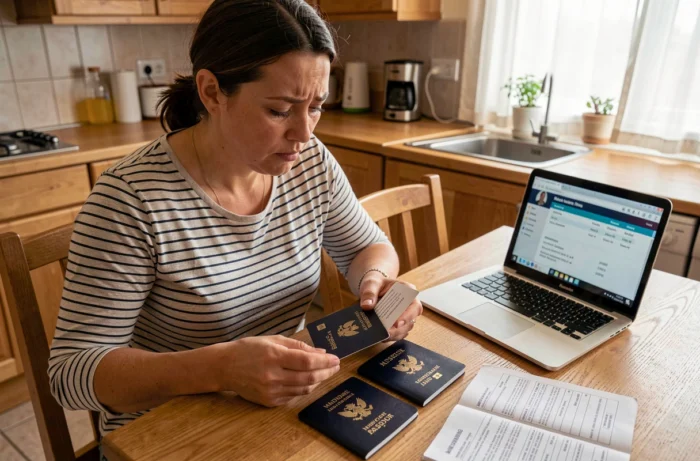
Divorce and the name on your passport: an update that does not happen automatically
After a divorce, the right to use a former spouse’s name may be retained or withdrawn, depending on the family court’s decision. Your passport, however, is not updated automatically.
In practice, a passport showing “ép. MARTIN” remains valid until its expiration date, even if the divorce has been finalized. But traveling with a document showing a married name you are no longer entitled to use may create a discrepancy with other documents you present (such as a new ID card).
The safest option after a divorce is to renew your passport so that it shows only your birth name or the married name authorized by the court ruling. This avoids questions during checks, especially outside the European area, where the concept of a married name is not always recognized.
Special case: blended families
Traveling with a child whose surname differs from yours may trigger additional checks in some countries. A family record book or travel authorization for a minor does not replace the need for names to match on travel documents, but these supporting documents can make border crossings easier.
The name on your passport is not a minor administrative detail. It is the information used by every automated system, every border control agent, and every authorization form to verify your right to board. Checking the MRZ, booking under the name shown there, and planning ahead for passport renewals after a change in civil status remain the only reliable ways to avoid being stopped on departure day.