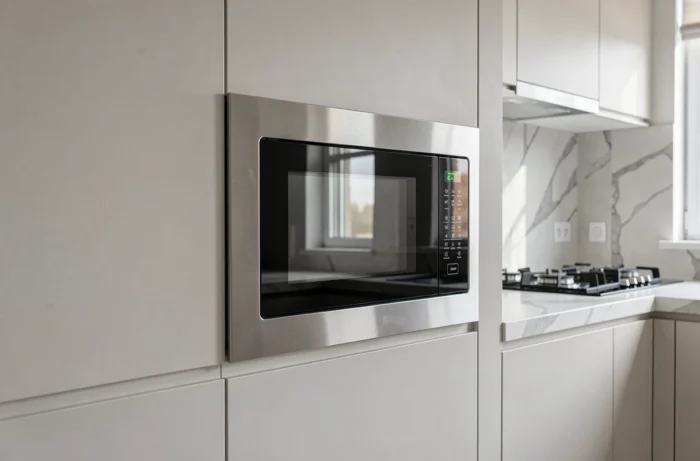
A built-in microwave fits into a furniture niche and frees up counter space. This promise of integration is appealing, but it also changes maintenance, budget, and installation constraints compared to a freestanding model. Comparing these two formats based on concrete criteria allows us to measure what built-in offers and what it truly costs.
Built-in microwave or freestanding microwave: comparative table of decisive criteria
| Criterion | Built-in microwave | Freestanding microwave |
|---|---|---|
| Counter space | None (fitted into a niche) | Takes up work surface |
| Purchase budget | Significantly higher for equal functions | Accessible entry-level |
| Installation | Fitting in niche, dedicated ventilation, connection required | Simple plug-in |
| Repair in case of failure | Removal from niche necessary, higher labor cost | Device directly accessible |
| Availability of parts | Variable depending on the manufacturer, technical documentation sometimes limited | Parts often standardized |
| Aesthetics and integration | Flush facade, cohesive kitchen line | Visible device, variable design |
| Model replacement | Niche dimensions to respect (risk of incompatibility) | Free choice of size |
This table highlights a gap that goes beyond just the purchase price. Built-in requires a long-term commitment: niche, ventilation, dimensions. A freestanding model can be replaced in a few minutes. A built-in may require a professional’s intervention and adaptation of the cabinet.
To better understand the advantages of a built-in microwave, one must look beyond aesthetics and consider the overall cost over several years.

Repairability of the built-in microwave: an underestimated angle
Buying guides emphasize visual integration and space-saving. They rarely address the issue of repair, even though it weighs heavily in the economic balance of a built-in model.
Removal, an invisible extra cost
When a freestanding microwave breaks down, you unplug it and take it to a workshop. For a built-in model, the breakdown involves removing the device from its niche, working on the fixing, ventilation, and electrical connection.
This removal work, followed by reinstallation after repair, generates a labor cost that the price of the spare part alone does not reflect.
Technical documentation and access to parts
The availability of parts is not enough. The manufacturer must also provide technical documentation usable by an independent repairer. Before purchasing, checking these points reduces the risk of having to replace the entire device for a minor failure:
- Does the manufacturer publish a breakdown of the device and a list of available spare parts?
- Are the parts accessible to repairers outside the authorized network, or reserved for internal customer service?
- Does the announced availability of parts exceed the legal warranty?
A built-in model whose parts disappear from the catalog after a few years becomes a disposable device fixed in a cabinet, which is the worst scenario.
Durability index and regulations: what changes for microwaves
The repairability index, already displayed on certain categories of devices in France (televisions, washing machines), does not yet cover microwaves. An extension to microwaves is announced in a second wave of regulations, in the form of a more comprehensive durability index.
Meanwhile, the European directive on the right to repair was to be transposed into French law by July 31, 2026, at the latest. The implementing texts had not yet been published as of the date of the available sources. No general right to repair outside of warranty is therefore guaranteed for a built-in microwave purchased today.
In practice, this means that consumers cannot yet rely on an official score to compare the durability of two built-in models. They must conduct this verification themselves by questioning the manufacturer about disassembly, announced reliability, and spare parts policy.
Power, capacity, and functions: what matters in a kitchen niche
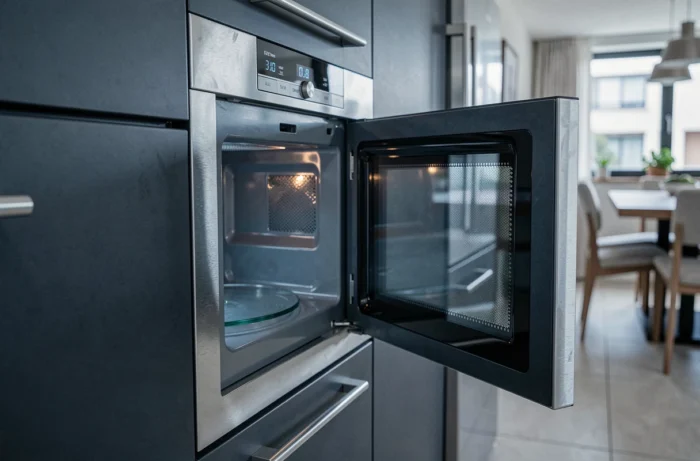
The built-in format does not escape the same selection criteria as a classic model. The difference lies in an additional constraint: the dimensions of the niche limit the available capacity and power.
A monofunction microwave is sufficient for reheating and defrosting dishes. A grill model adds the possibility of browning and crisping food. The combination model also includes convection heat, making it a versatile cooking appliance capable of partially replacing a traditional oven.
- Monofunction: reheating, defrosting, steam cooking with appropriate accessory. Generally sufficient power for daily use.
- Grill: functions of the monofunction plus browning and crisping. The browning plate also allows for searing from below.
- Combination (convection): complete cooking, but significantly higher price and sometimes larger footprint.
However, a high-performing built-in combination model requires effective rear ventilation. If the niche does not provide sufficient clearance, thermal dissipation is compromised, and the lifespan of the appliance decreases.
Before choosing the function, it is essential to measure the niche. The capacity of the turntable directly depends on the interior volume, which is constrained by the dimensions of the cabinet. A large dish will not fit in a compact built-in model, regardless of the number of functions displayed.
The choice of a built-in microwave hinges less on aesthetics than on three concrete parameters: the exact size of the niche, the manufacturer’s spare parts policy, and the type of cooking actually practiced daily. A well-sized and repairable appliance remains functional much longer than a high-end model stuck in an unsuitable niche.