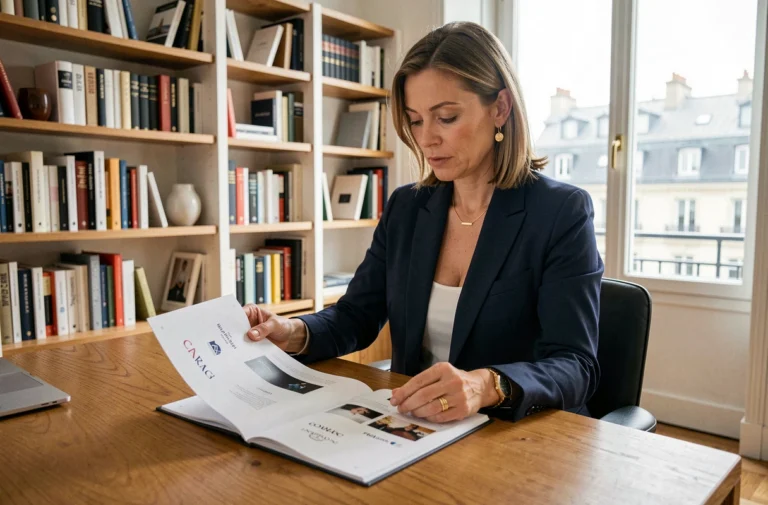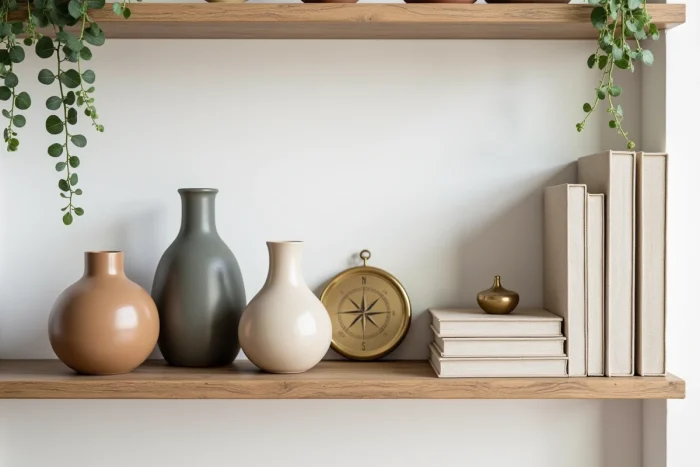
A unique object does not decorate by its mere presence. It decorates by the space given to it, the emptiness created around it, and the connection it maintains with the rest of the room. Decorating and organizing an interior with singular objects relies on a principle often overlooked: selection takes precedence over accumulation, and staging transforms a simple trinket into a focal point.
Unique objects and visual clutter: the trap of decorative accumulation
The most common temptation when collecting handcrafted pieces, thrift store finds, or repurposed objects is to display everything at once. The result quickly resembles a warehouse rather than a thoughtfully designed interior.
A singular object gains presence when it breathes. This means that a shelf with three spaced pieces will have more visual impact than a surface completely covered. The emptiness around an object acts like a frame: it directs the gaze.
For those looking for strong personality pieces without spending hours at flea markets, it is possible to discover the Bazardons website, where objects with varied backgrounds intersect, ready to find a second life in a well-kept interior.
Regular sorting is part of the process. Keeping five standout objects in a living room creates a clearer effect than fifteen average pieces scattered about. The idea is not to empty the room but to rotate: store some objects for a few months, then bring them back out. The gaze refreshes, and each piece regains its power of attraction.
Decorative upcycling: transforming a mundane object into a storage piece
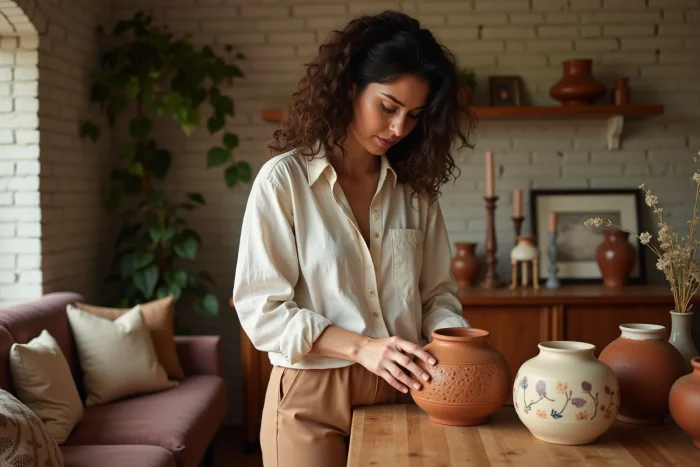
Upcycling goes beyond simple recycling. It involves taking an existing object, often destined for the trash or attic, and assigning it a new decorative or practical function. This approach stands as a concrete response to the standardization of interiors.
A telling example: a sanded old wooden crate fixed to the wall becomes an open shelf for the bathroom. A salvaged painter’s ladder serves as a towel rack or a display for throws in a living room. Upcycling combines storage and decoration in a single gesture.
Success hinges on a technical detail: the repurposed object must retain a visible trace of its original function. An antique suitcase used as a side table works because the suitcase is recognizable. If the object is too transformed, it loses its uniqueness and resembles cheap new furniture.
What works in decorative upcycling
- Open containers (crates, baskets, industrial jars) that allow for storage while displaying their contents, useful in a kitchen or office
- Furniture with dual purpose: a trunk that serves as an entry bench with integrated storage, or a construction spool transformed into a coffee table
- Repurposed wall objects: an old window frame becomes a wall organizer with hooks, a salvaged door is mounted as a headboard
Artisan craftsmanship and narrative value: choosing objects that tell a story
Recent content on interior decoration shows a clear shift. The focus is no longer solely on the visual style of an object but on its story: who made it, from what material, and with what technique.
Artisan craftsmanship becomes a differentiating argument against mass-produced objects. A hand-thrown ceramic, a forged metal light fixture, or a handwoven textile carry irregularities that testify to the act of creation. These micro-defects are precisely what makes them unique.
The challenge for interior organization is to give these pieces a place proportional to their narrative value. An artisan vase placed between two stacks of mail loses all its effect. The same vase placed alone on a console, illuminated by a table lamp, becomes the visual anchor of the entryway.
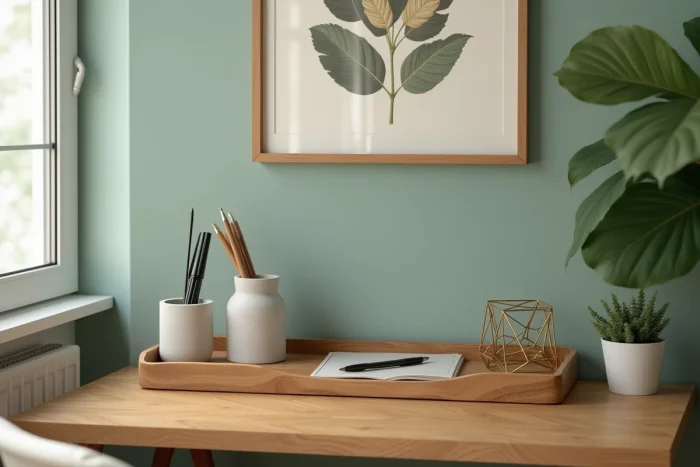
Staging a handcrafted object in a room
Staging relies on three simple levers. The first is height: varying exposure levels (floor, table, high shelf) prevents the eye from sliding without stopping. The second is material contrast: placing a raw pottery piece on a smooth surface, or a wooden object against a light wall.
The third lever is directed light. A directional spotlight or a clip lamp aimed at an object is enough to create a visual hierarchy in the room. The light tells the gaze where to settle.
Storage and interior decoration: merging the two instead of opposing them
Many interiors treat storage as a problem to hide and decoration as a layer to add on top. This separation creates schizophrenic spaces: closed cabinets on one side, objects placed without logic on the other.
A more coherent approach is to use storage solutions themselves as decorative elements. Open shelves are the most common example, but the principle goes further.
- Boxes made of noble materials (raw wood, woven wicker, patinated metal) lined up on a console serve both as storage for everyday small items and as a visual composition
- A perforated wood panel fixed in an office holds hooks, pencil pots, and small frames, transforming the workspace into an organized and personalized wall
- Hanging baskets in a kitchen replace high cabinets while displaying fruits, utensils, or dried herbs
Visible storage forces selection, which aligns with the initial principle: fewer objects, better chosen, better placed. Each displayed element must earn its place, both for its function and its appearance.
An organized interior with unique objects does not require an extravagant budget or decorator talent. It requires a discipline of sorting, an eye for proportions, and the willingness to leave empty space where instinct urges to fill. The most successful spaces are often those where one object has been removed rather than added.